Understanding Tree Dynamics with Video-Based Vibration Analysis

How University of Cambridge engineers used WaveCam to complement sensor measurements and structural modelling for the Great London Plane of Ely

Engineering support for a living structure

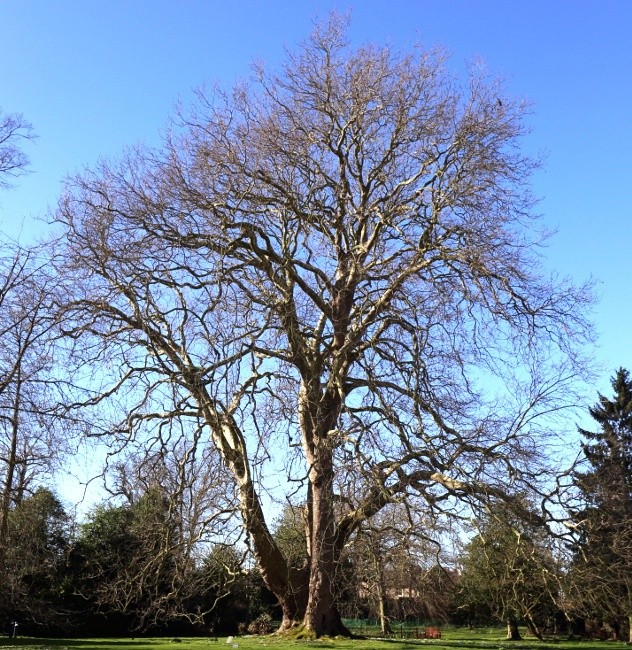
The Great London Plane of Ely is believed to have been planted in 1674. At more than 40 metres tall, it is recognised by The Tree Council as the largest London plane in the UK and one of its Top 50 Great British Trees. Although the tree is in good health, a whole-tree survey showed that additional support is required to help it continue to prosper.

Engineers at the University of Cambridge are working with arborists to develop a cable-bracing system for the tree. The aim is to support key areas while allowing the tree to retain natural movement. To guide the design, the team built a structural finite-element model from LiDAR geometry and measured the tree’s wind-driven response with accelerometers.

The measurement challenge

The exceptional scale and complex branching structure of the tree make dynamic measurement difficult. Accelerometers provide accurate data at their installed locations, but only a limited number could be fitted. The team therefore needed an additional way to interpret the point measurements and observe how larger parts of the tree moved together.

WaveCam for video-based operational modal analysis

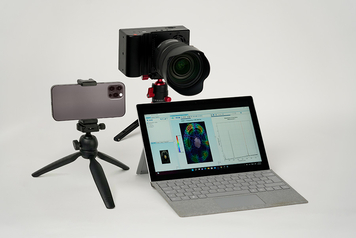
WaveCam was used to perform operational modal analysis from video. Recordings were captured from several ground-level viewpoints with a tripod-mounted iPhone SE. Each analysis used 50 seconds of video recorded at 24 frames per second, corresponding to 1,200 frames and a frequency resolution of 0.02 Hz.

The setup was completed within a few hours. Because the analysis was based on video, it provided a full-field view of visible sections of the tree without adding further sensors or cabling to the branches. In this project, WaveCam complemented the accelerometers; it did not replace the wider structural assessment.

Measurement workflow

  1. Capture the tree from multiple viewpoints while it is excited by natural wind loading.
  2. Analyse the videos in WaveCam to identify frequency content and operational deflection shapes.
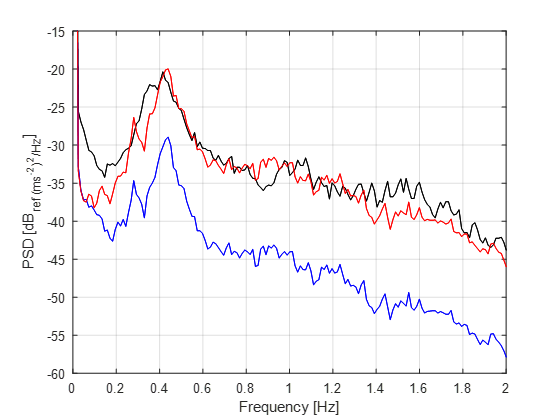
  3. Compare the visualised mode shapes with peaks in the tri-axial accelerometer spectra.
  4. Use the combined evidence to support interpretation and validation of the finite-element model.

Results: making dominant vibration modes visible

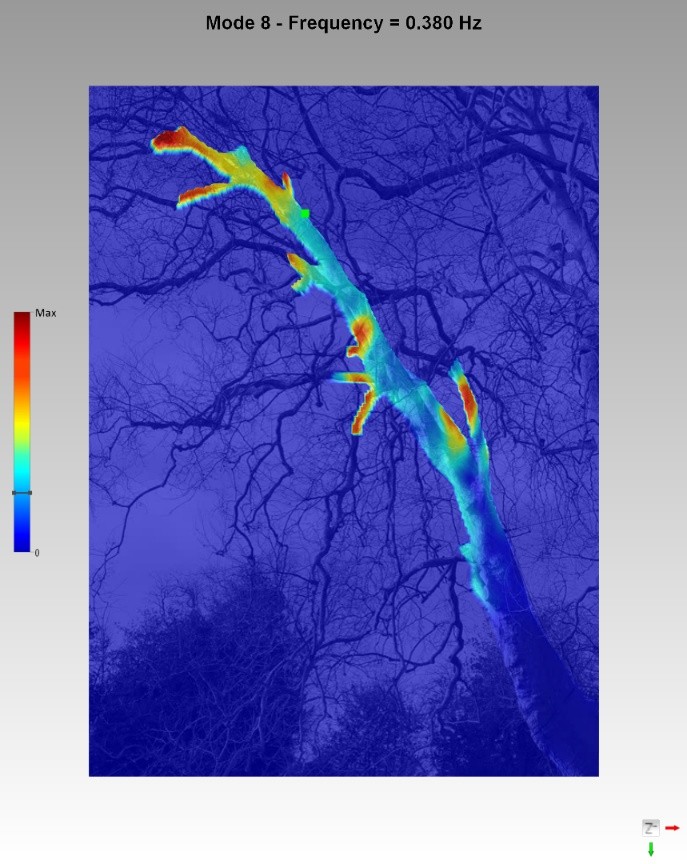
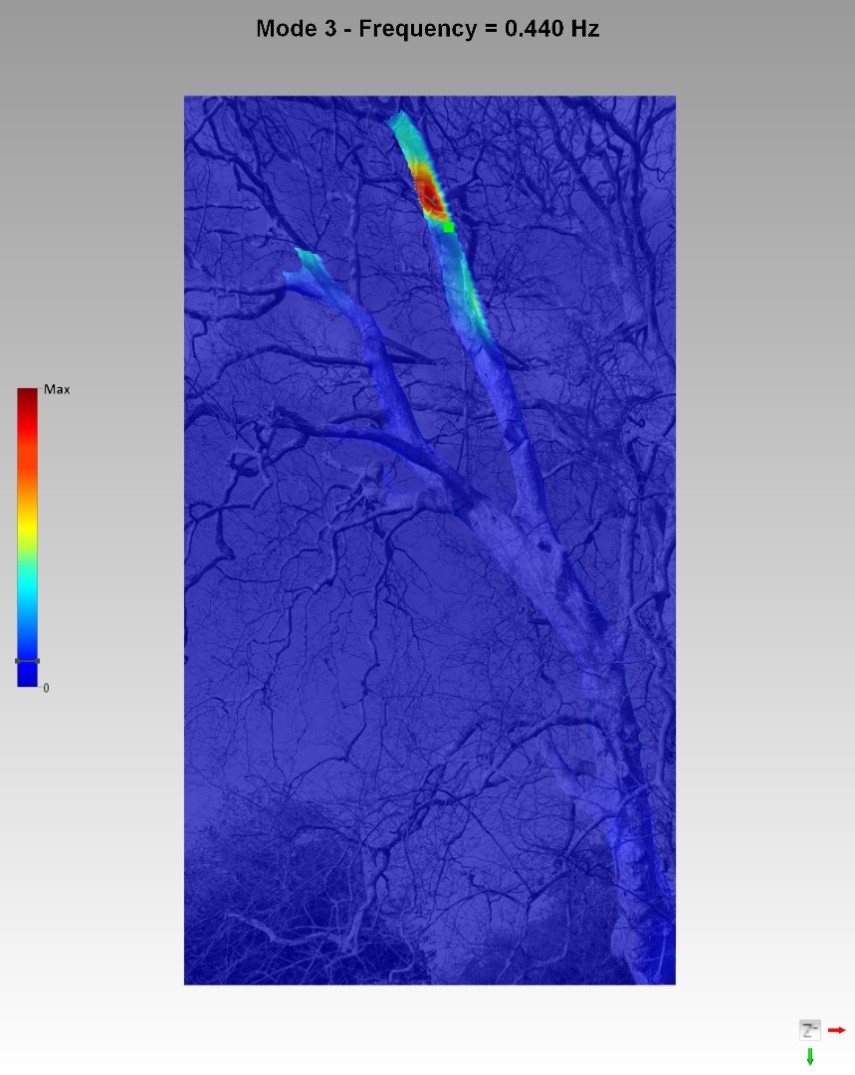
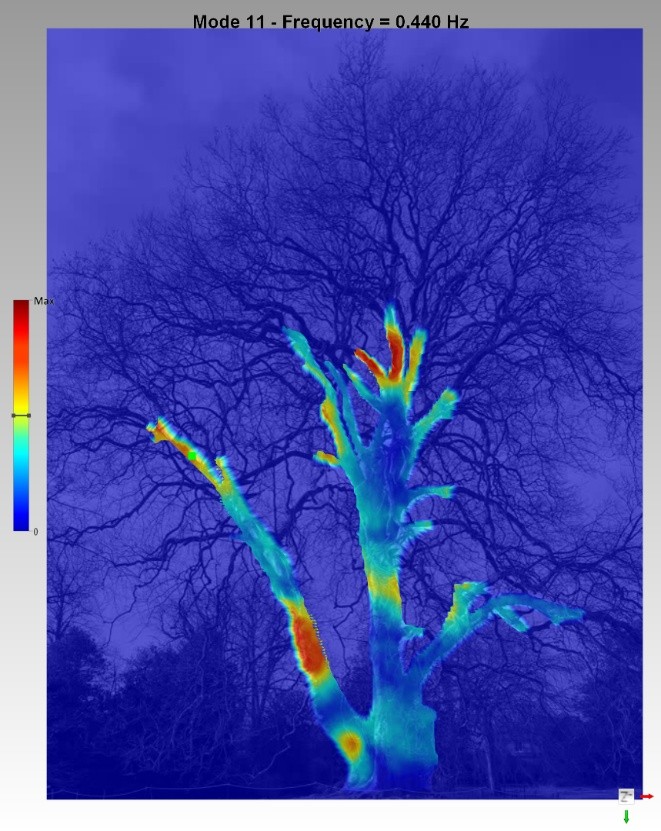
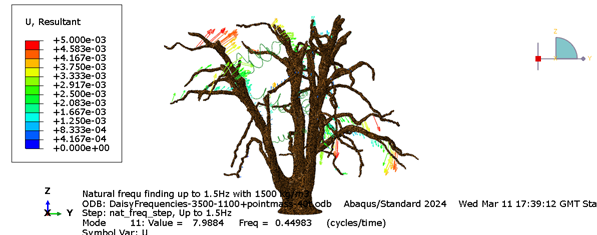
The recordings showed clear local and global vibration modes. On the southern limb, the WaveCam results visualised bending responses at approximately 0.38 Hz and 0.44 Hz. A whole-tree operational deflection shape was also identified at approximately 0.44 Hz.

These mode shapes helped associate spectral peaks in the accelerometer data with specific movement patterns. They provide additional evidence for identifying dynamic bending behaviour in parts of the tree affected by damage and decay, informing the engineering assessment behind the planned bracing system.
Source:

Where video-based vibration analysis adds value

  • Large or geometrically complex structures where only a limited number of sensors can be installed.
  • Full-field visualisation that helps relate frequency peaks to spatial movement patterns.
  • Ground-level recording for visible parts of structures that are difficult to access.
  • A complementary evidence layer for finite-element model validation and engineering interpretation.
  • Flexible video input, from compatible smartphone footage to high-speed camera recordings, depending on the measurement task.

Technical setup in this application

Measurement object

Great London Plane of Ely, East Cambridgeshire, UK

ExcitationNatural wind loading

Camera

iPhone SE on a tripod

Frame rate

24 fps
Recording length50 s / 1,200 frames
Frequency resolution0.02 Hz
AnalysisVideo-based operational modal analysis with WaveCam
Complementary dataLiDAR geometry, tri-axial accelerometers and a finite-element model

Video Vibration Analysis

Make Vibration Visible

Explore WaveCam for contactless, full-field vibration analysis from video. Discover the software, use our professional vibration analysis service or find answers to frequently asked questions about video-based vibration measurement.