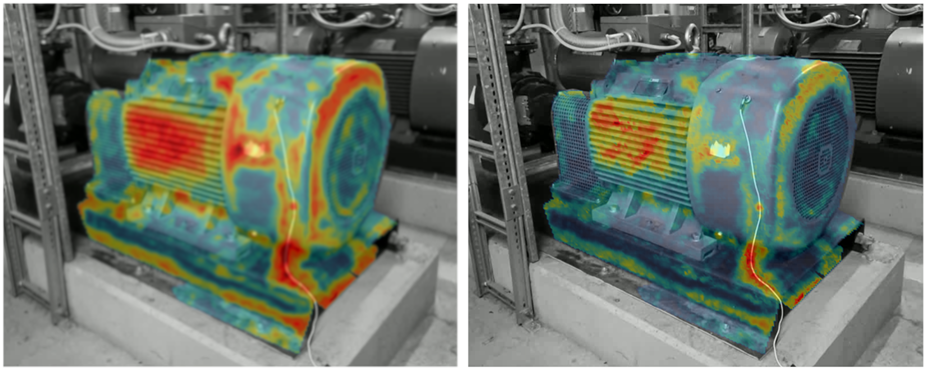
Effective machine condition monitoring requires more than a single vibration level. RMS, crest factor and phase are normally assessed together to detect changes and distinguish between possible fault mechanisms. RMS indicates the overall vibration level, while crest factor reveals short-duration impacts relative to that level. Phase shows how different parts of the machine move in relation to each other. Together, these parameters can reveal developing faults before they result in unplanned downtime or costly repairs.
A developing rolling-element bearing fault illustrates this well. At an early stage, isolated impacts raise the peak level and therefore the crest factor, while RMS may change very little. As the damage progresses, the impacts occur more frequently and RMS begins to rise. The crest factor may then fall even though the bearing condition is worsening. RMS alone can therefore miss the onset of damage, while crest factor alone can be misleading at a later stage. Their trends should always be interpreted together.
WaveCam's time-domain analysis calculates full-field RMS, crest factor and phase maps from a single video. These maps show where vibration is strongest, where impulsive behaviour occurs and where phase patterns become irregular. This makes areas requiring further investigation easier to identify, even without advanced vibration-analysis expertise. Used alongside frequency spectra and conventional vibration sensors, WaveCam adds spatial context and enables the results to be cross-validated. This supports reliable condition assessment and predictive maintenance without a complex measurement setup.
Many low-frequency fault signatures associated with unbalance and mechanical looseness can be investigated using smartphone footage recorded at 240 frames per second. Our separate FAQ explains how to record suitable footage for WaveCam analysis.